How a fabrication quote should show material loss on its own line
Pricing only finished part area understates the sheet bought. Split purchased stock, shipped parts, and leftover on the quote.
A fabrication quote that prices only the finished area of sheet-metal, plate, or plywood parts understates the sheet the shop had to buy. The customer is paying for material purchased — the stock size on the supplier ticket — not only for the pieces that leave in the crate. Before the quote goes out, put three quantities on their own lines: material purchased, material that ships as parts, and material left in the shop.
What the quote should put on each line
What is being counted
The purchased sheet or plate the shop must buy to nest the job, converted to money from that stock’s listed size and weight, not from the finished part outline.
What is not being counted
Machine time, pierce time, or the cutter’s slot as a separate fee. Those belong on other lines. Shop leftover is leftover. It is not a shipped part and it is not free stock unless another named part actually fits on it.
The measurement that decides it
Purchased length times purchased width (and thickness when the price is by weight), set next to the nest: parts that ship versus skeleton, edge strip, and offcut that stay.
What a catalog figure leaves out
A mill extras book prices coil and sheet by the hundredweight. A service-center listing gives stock sizes and pounds per square foot. Neither figure is the area of the nested parts, and neither figure is the leftover still on the table.
Check before the batch or the quote
Open the supplier page for that exact sheet or plate. Record the stock size, the thickness, and the weight per square foot next to the nest. Do not replace those with the sum of the part areas.
Last checked
29 September 2026
What the cutter leaves on the purchased sheet
A laser, a plasma arc, a waterjet, or a saw does not buy the stock. Purchasing already owns a sheet or a plate before the first pierce. The beam, the jet, the arc, or the toothed blade removes a slot between parts and around each profile. What remains on the table is the skeleton, the clamp border at the sheet edge, and any offcut that did not become a part. Those leftovers are still the same grade and thickness as the purchased sheet. They are not the parts that ship.
Keep three buckets visible on the quote, with names the customer can point to:
- Material purchased — the sheet or plate the purchasing line actually ordered, at the size the supplier sells.
- Material that ships as parts — the nested profiles that leave in the crate.
- Material left in the shop — skeleton, unusable strips, and any offcut large enough for another part.
The customer is paying for the first bucket. The second bucket is what the drawing asked for. The third bucket is why a price built only on finished part area is short. An offcut is still material only when another part fits on it. A strip too narrow to nest is scrap. Scrap still carries the purchase price of that stock. It does not become a credit unless the shop sells it as scrap and the quote says so.
Each cut between parts consumes a strip. Counting finished rectangles against the sheet area overstates how many parts fit. The clamp border and the skeleton change the count even when the slot width stays the same. The quote’s material line has to follow the purchased rectangle, not the sum of those rectangles.
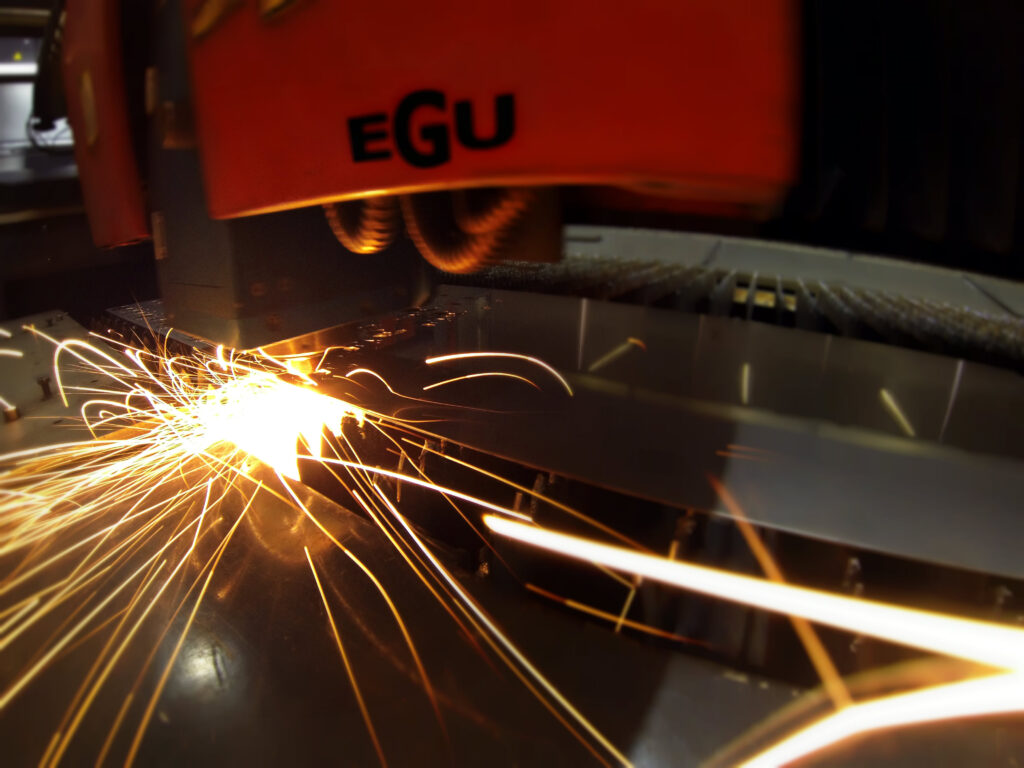
Photo: EGU-Metall, Wikimedia Commons, CC BY-SA 3.0. No changes made.

How a sheet leftover differs from a bar leftover
On a sheet, loss is area: the slots between parts, the skeleton, and the edge margin that the clamps or the nest never used. On a bar, a pipe, or an extrusion, loss is length: the cutoff between pieces and the remnant too short to finish. Those two counts do not substitute for each other. A sheet nest can look full and still leave a web that will not take another part. A bar drop can look small and still kill the last piece. Put sheet leftover in area, or in the weight of that leftover at the listed pounds per square foot. Put bar leftover in length. Do not copy one waste figure from a bar job onto a plate nest, and do not hide both under a single blended percent.
The cutter still matters for what the leftover looks like — a laser web, a saw cutoff, a plasma edge — but the quoting error is the same if the material line pretends the shop bought only the finished outline. Machine time stays on its own line either way. A slow nest does not change how many pounds of plate had to be purchased.
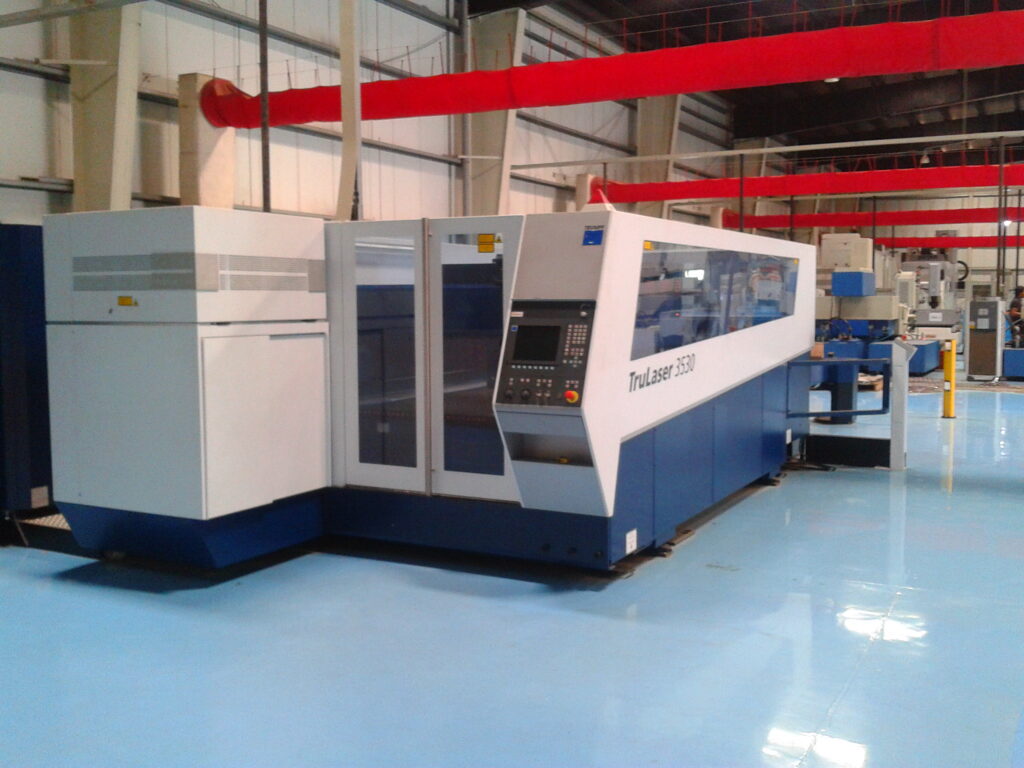
Photo: S zillayali, Wikimedia Commons, CC BY 3.0. No changes made.

What to open on the supplier page before the quote
On 29 September 2026, the Metals Depot A36 plate listing named ready stock sizes of 4 ft by 8 ft and 5 ft by 10 ft, and said stock sizes may vary by plus or minus 1/4 in. The same page listed 1/4 in A36 plate at 10.21 lb per square foot and 3/16 in A36 plate at 7.66 lb per square foot. A 4 ft by 8 ft plate is 32 square feet. At 10.21 lb per square foot that purchased plate weighs 326.72 lb before anyone nests a part. The material line on the quote is that purchased plate, at the shop’s cost for that plate, not 32 square feet minus the holes and not the sum of the part outlines.
The same day’s steel-sheet listing from that supplier gave 16 gauge (0.060 in) hot-rolled ASTM A1011 sheet at 2.50 lb per square foot, with stock-size variation of plus or minus 1/8 in and a cut-to-size tolerance of plus or minus 1/16 in. If the shop buys a full sheet, the customer is paying for that sheet’s area times 2.50 lb per square foot, even when the nest uses only part of it. A cut-to-size blank still has a purchased length and width. Price that blank. Do not price only the part that will be cut from it.
U.S. Steel’s North American flat-rolled price book, opened the same day, states that all prices are in U.S. dollars per 100 pounds ($/cwt) and that hot-rolled product is sold on an actual-weight basis. The mill product described there is typically a mill-edge coil ordered to a minimum thickness. Cut-edge extras sit on their own lines: $2.50 per hundredweight for cut edge that is not pickled, and $0.50 per hundredweight more when the edge is pickled, on top of the pickle extra. An order item under 40 tons carries a $1.25 per hundredweight extra. None of those mill lines is a finished-part area. A catalog hundredweight does not tell the estimator how much of a bought 4 ft by 8 ft or 5 ft by 10 ft plate will remain as skeleton.
On the quote packet, look for four facts next to any width or weight: the material, the thickness, the process that will cut it, and the purchased stock size. Then look for the nest that shows parts plus leftover. If the material line matches the purchased sheet, the leftover can be discussed. If the material line matches only the part outlines, the leftover has already been hidden.
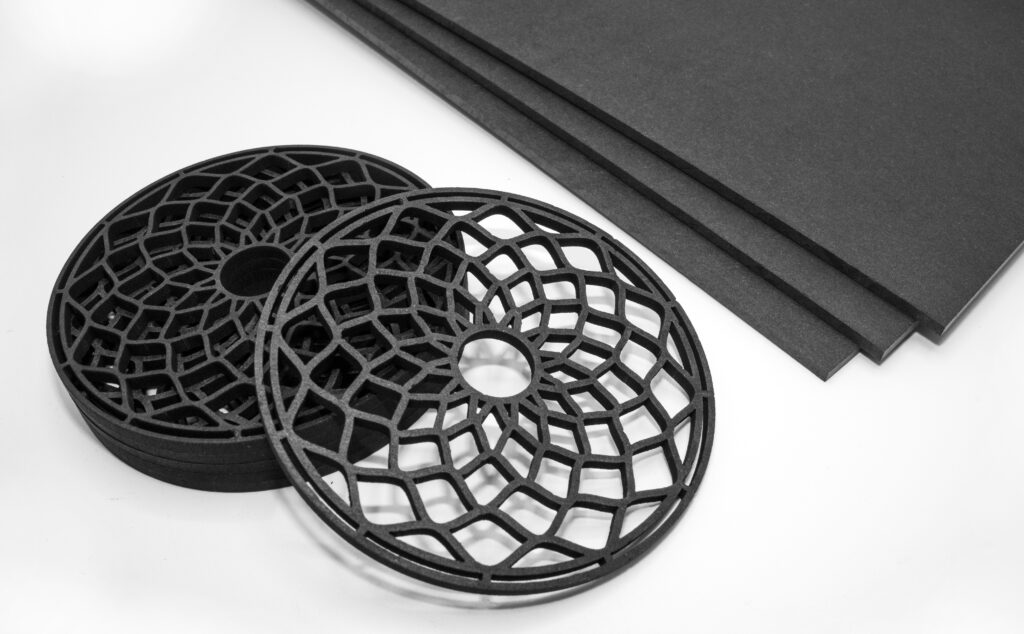
Photo: Jeanette Ekren, Wikimedia Commons, CC BY-SA 4.0. No changes made.

The choice before the nest or the quote is sent
Keep the offcut on the quote only when another part from this order, or a named later job, actually fits on it. If the nest cannot fill the purchased 4 ft by 8 ft or 5 ft by 10 ft plate, either buy a smaller listed size from the same supplier list, change the nest, or show the unused area as leftover on its own line. Do not bury leftover inside a blended “material” number that looks like finished part area. Leave machine time on a separate line. If material, thickness, process, and purchased stock size are not all known, leave the waste percent blank. Do not invent one from a previous job in a different thickness or a different form of stock.
The decision the estimator is making is not which cutter to buy. It is whether the customer can see that they are paying for the sheet that had to be purchased, including the skeleton that will still be in the shop when the parts ship.
The purchased plate is heavier than the parts that ship
A 4 ft by 8 ft by 1/4 in A36 plate at 10.21 lb per square foot is 326.72 lb of purchased steel. Every part that ships is cut from that weight. The difference between 326.72 lb and the weight of the shipped parts is the shop leftover plus the slot the cutter removed. That difference is why the material line cannot be “part length times part width times a catalog pound-per-square-foot.” The pound-per-square-foot figure on the supplier page is for the stock, and it applies to the whole purchased rectangle. Using it only on the finished outline understates the plate that had to be bought.
The same arithmetic applies to thinner sheet. Sixteen-gauge hot-rolled A1011 at 2.50 lb per square foot still prices the purchased sheet, not the nested islands. Coil bought from a mill on an actual-weight hundredweight is the same idea one step earlier: the shop pays for the coil weight that arrived, then for the sheets cut from it, then still has leftover after the nest. Each handoff needs its own line so the customer can see which weight they are covering.
The mistake that makes the quote wrong
Pricing the job as if the customer were buying only the finished part area. That understates the sheet or plate that had to be bought, hides the leftover in the shop, and often mixes machine time into material. The customer is paying for material purchased, not only for material that ships as parts.
Read next: How to turn sheet waste into a cost for one batch. How an offcut differs from scrap on a repeat job.