How a saw, a laser, a plasma arc, and a waterjet open different slots in the same stock
A saw, laser, plasma arc, and waterjet each open a different slot. Remeasure the coupon when the process changes, even if the drawing does not.
A saw, a laser, a plasma arc, and a waterjet each open a slot through wood, sheet metal, acrylic, or other plate. That slot is the stock you lose between finished pieces. The drawing can stay the same while the slot changes shape and width, so recut a coupon in the new process before the nest or the quote uses a width.
Answer box
- What is being counted
- The slot each process removes as it separates parts from the parent sheet or board. ISO 9013:2017 defines thermal kerf width as the width of that cut at the upper edge, or immediately below if the top edge has melted (opened 29 September 2026).
- What is not being counted
- The finished outline on the drawing, machine time, a later mill or grind allowance, and any press-fit or joint clearance after the slot is already cut.
- The measurement that decides it
- A caliper reading of the slot on a test coupon cut in the same material, thickness, process, and machine. For an abrasive waterjet, OMAX tells the operator to measure at the widest point of that slot (opened 29 September 2026).
- What a catalog figure leaves out
- The Freud P410 10-inch general-purpose blade lists a kerf of 0.126 in and a plate of 0.098 in (opened 29 September 2026). Those figures are the maker’s tooth and plate widths for that blade. They do not name a measured slot in a stated thickness of plywood or hardwood on a stated saw.
- Check before the batch or the quote
- If the job moves from a toothed blade to a beam, an arc, or a jet, recut the coupon. After a blade, nozzle, or mixing-tube change, the old measured slot is no longer the slot. Record material, thickness, process, and machine next to any width. If one of the four is missing, leave the width blank.
- Last checked
- 29 September 2026
What each cutter is taking out of the sheet
A circular saw removes a toothed slot you can see. The carbide teeth stand wider than the steel plate so the plate does not pinch in the cut. On the Freud P410 listing, that tooth width is 0.126 in and the plate behind it is 0.098 in. The leftover you can point to on a plywood or hardwood sheet is the board edge, the strip between blanks, and any offcut that is still wide enough for another part. The slot itself is the strip that is gone.
A laser does not leave a toothed groove. A focused beam and an assist gas melt or vaporize a path. The width of that path depends on power, speed, focus, and thickness, not on a row of teeth. Bystronic’s ByCut Quality Cut Package describes BeamShaper as producing a larger kerf width on thicker structural steel so parts come out of the skeleton more easily, and it states that combination can cut structural steel up to 1.18 in (opened 29 September 2026). That page does not publish one measured slot for a named thickness on a named machine, so that width stays blank here. The leftover on a laser nest is still a skeleton and an edge margin. The beam only changes how much metal is missing between those leftovers.
A plasma arc opens a slot by constricting an ionized gas jet through a nozzle and blowing molten metal out of the kerf. Hypertherm states that the plasma column changes size with amperage, voltage, gas flow, and torch speed, and that nozzle orifice size also sets the kerf because the orifice constricts the jet to a particular diameter (opened 29 September 2026). The same page gives a worked estimate: a 200 amp air nozzle with an orifice of 0.086 in has an estimated kerf of about 0.129 in, using a factor of 1.5 on that orifice. Conventional plasma also leaves a beveled face. Hypertherm lists typical bevel of 1–3 degrees on the “good” side of the cut and 3–8 degrees on the other side. ISO 9013:2017 applies to plasma cuts from 0.5 mm to 150 mm and to laser cuts from 0.5 mm to 32 mm. It treats top kerf width and bottom kerf width as separate quantities on the same cut, which is why a plasma slot is not a parallel saw slot even when someone writes down a single millimetre.
A waterjet erodes a slot with a high-pressure stream. On an abrasive head the water first passes a jewel orifice, then mixes with garnet in a mixing tube before it hits the plate. KMT Waterjet states that a 50-HP pump at 60,000 PSI supports a maximum orifice of 0.014 in, and the same horsepower at 90,000 PSI supports a maximum orifice of 0.010 in, and that the larger the orifice, the wider the kerf (opened 29 September 2026). The same page gives a focusing-tube example: a 0.014 in jet paired with a 0.030 in focusing tube. OMAX’s ProtoMAX help states that abrasivejet kerf can range from 0.021 in to 0.060 in depending on the nozzle, the thickness, and mixing-tube wear, and that the kerf is measured at its widest point (opened 29 September 2026). As the mixing tube wears, that slot grows and can become elliptical, so the offset is no longer the same in every direction.
The parts you can point to on the table are the blade or the nozzle, the sheet edge, the skeleton left in the nest, and any offcut. None of those leftovers is the slot. The slot is the material the cutter already removed.
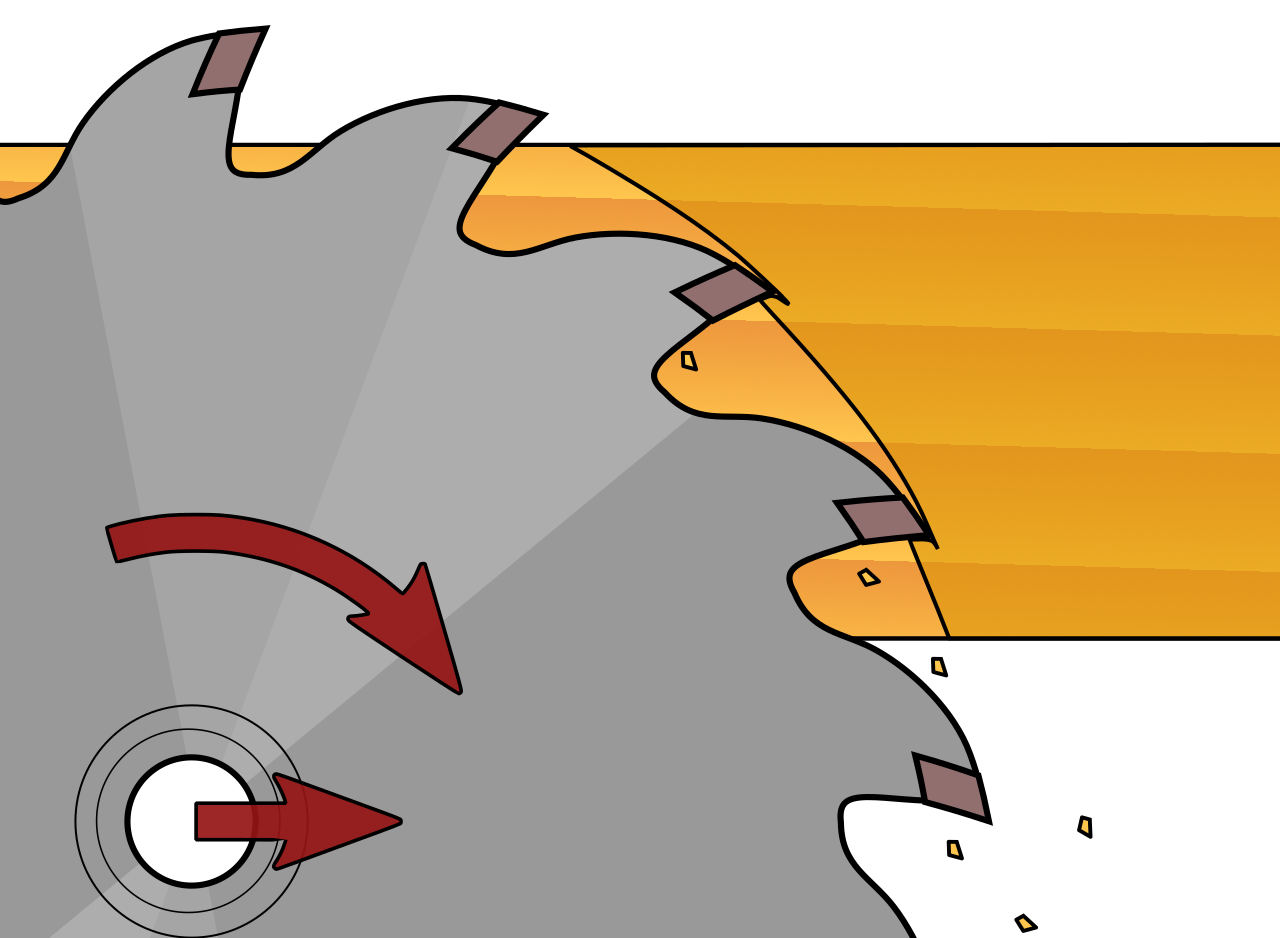
Circular saw blade cutting wood, Westbahnhof, CC BY-SA 4.0, via Wikimedia Commons.

When the process changes, the nest and the coupon both change
A catalog blade kerf and a measured coupon fail in opposite ways. The Freud listing tells you what that tooth is supposed to be before the blade is mounted. The coupon tells you what the slot became in this sheet on this machine after the teeth, the beam, the arc, or the jet actually ran. Copying the 0.126 in listing onto a laser nest, or copying last month’s waterjet offset onto a plasma nest, treats those two measurements as if they were the same number.
The comparison that belongs here is a saw versus a laser on the same drawing. The saw slot is set by a toothed width you can read on a spec sheet. The laser slot is not printed that way on the ByCut page. It is a result of power, speed, thickness, and, on some setups, a beam-shaping option that the maker says widens the kerf on thick structural steel. If the shop moves a nest from the table saw to the laser because the next operation needs a different edge, the strip between parts changes even though the DXF did not. The first part off the new process is the check. A caliper on that part is the new slot. The old saw number is not.
Thickness is a second trap on the same machine. Hypertherm’s Powermax65 production chart lists 65 A mild steel at 1/4 in (6 mm) at 116 ipm and the same current at 1/2 in (12 mm) at 40 ipm (opened 29 September 2026). That chart is speed, not kerf, but it shows the process changing with thickness while the material name stays “mild steel.” A setting that cut a thin sheet is not a setting for a thicker sheet. Measure again. ISO 9013 also separates top kerf width from bottom kerf width. If the estimator counts one rectangle of waste per cut, a tapered plasma or laser slot and a toothed saw slot will not cost the same strip.
On a waterjet the job changes the loss in a different way again. OMAX states that a slower cut (a higher quality number) widens the kerf and that a test part must be cut at the same quality and in the same material as the job. A prototype run at a fine quality therefore removes a wider slot than a production run at a faster quality, even when the nozzle and the plate have not changed. Recount the nest when the quality number changes. One slot is a small loss. The same slot on every cut in a production run is a stack of sheets.
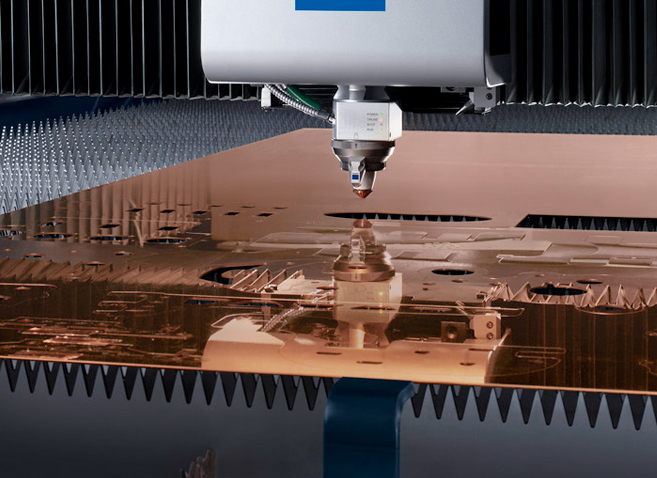
Laser cutting of copper, TRUMPF GmbH + Co. KG, CC BY-SA 3.0 DE, via Wikimedia Commons.

What to read on the blade, the nozzle, and the coupon
Open the current listing, not a remembered number. A useful record names the material, the thickness, the process, and the machine next to the measured slot. A forum post, a product photo, or a video is not that measurement.
On 29 September 2026 the Freud P410 product page listed diameter 10 in, 40 teeth, arbor 5/8 in, kerf 0.126 in, and plate 0.098 in, for ripping and crosscutting wood, laminate, veneered plywood, hardwood, and melamine on a table saw or miter saw. Look for the kerf and the plate as two different figures. The kerf is the tooth. The plate is thinner. Neither figure is a coupon. After that blade is swapped, the old measured slot is no longer the slot.
On the same date Hypertherm’s cut-angularity page stated the 0.086 in orifice and 0.129 in estimated kerf example and told the operator to cut test pieces, measure them, and adjust kerf compensation until the part measures correctly. Look for nozzle amperage, orifice size, and whether the compensation on the control is entered as the full kerf or half of it. The same maker’s Powermax65 page lists FineCut consumables as the thin-metal set for a clean edge and a narrow kerf. That sentence is a consumable family, not a measured width in a named thickness.
KMT’s pressure article, opened the same day, tied orifice size to pump pressure and kerf width. OMAX’s ProtoMAX measuring-kerf page, also opened that day, said to measure a test part cut at the same quality and in the same material as the job, and that mixing-tube wear widens the slot and can make the stream elliptical. Look for orifice, mixing-tube diameter, abrasive mesh, quality or speed, and mixing-tube hours—not only the last offset stored in the control. Bystronic’s ByCut page, opened the same day, stated BeamShaper as a larger kerf width for thicker structural steel up to 1.18 in. Look for whether that option is on for this nest. Do not invent a millimetre from that sentence.
ISO 9013:2017, opened the same day from the ISO preview, is the definition page for thermal kerf width at the upper edge. It names top kerf width and bottom kerf width as different symbols. It is not a kerf table for a named machine. If the four facts are not all on the page in front of you, the width stays blank.
The choice before the nest or the quote
The decision this topic turns on is whether to remeasure on a coupon—or leave the width blank—when the process changes.
If the four facts are known and the coupon was cut in this material, this thickness, this process, and this machine after the current blade, nozzle, or mixing tube went on, the nest can use that measured slot. If the drawing is unchanged but the cutter is now a laser instead of a saw, or a waterjet instead of plasma, recut the coupon. If a catalog tooth width is all you have, do not treat it as the slot in the sheet. If one of the four facts is missing, leave the width blank rather than copy a millimetre onto every page.
Do not pick a process here because it is faster. A fast process is not the same thing as an edge the next bend, weld, or paint line can use. That choice belongs with the edge afterward, not with a single remembered kerf. Keep the offcut only when another part still fits on it. The slot you just removed does not turn a too-narrow strip into free stock.
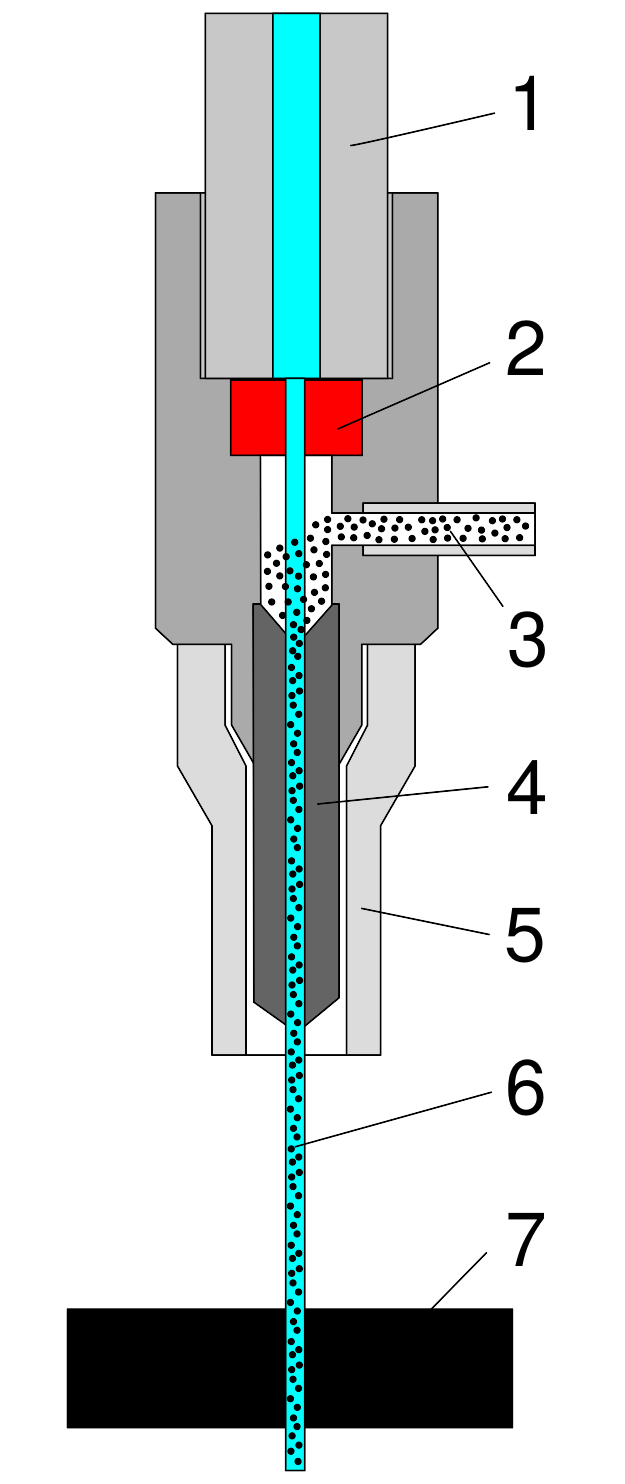
Water jet cutter head, Zureks, public domain, via Wikimedia Commons.

The slot that belongs to an abrasive jet
OMAX states, for its ProtoMAX abrasivejet, that kerf width can range from 0.021 in to 0.060 in depending on the nozzle, the thickness of the material, and mixing-tube wear, and that the width should be taken at the widest point. That range is a maker figure for that family of nozzles on that help page. It is not a kerf for a saw blade, a laser head, or a plasma torch, and it is not a measured slot until the coupon from this sheet is in the caliper.
KMT’s orifice pair—0.014 in at 60,000 PSI versus 0.010 in at 90,000 PSI on a 50-HP pump—is the reason two waterjet cells can remove different strips from the same plate even when both are called waterjet. A focusing tube at about twice the orifice diameter, in KMT’s 0.014 in / 0.030 in example, is still a consumable listing. After the mixing tube is rotated or replaced, the old measured kerf is no longer the slot.
The mistake that makes the count wrong
The harmful mistake is to keep one kerf in the nest after the process changes.
The drawing still looks right. The part count still looks full. The slot is now a different shape and a different width, so every cut between parts takes a different strip, the skeleton changes, and the first piece off the machine is the wrong size. Recut the coupon in the new process before the batch or the quote uses a width.
Read next: What a test coupon is for before a kerf number is used on a batch · Why thickness changes the cut even when the material name stays the same