Why Fabric, Foam, and Label Stock Leave a Different Waste Shape Than Sheet Metal
Fabric, foam, and labels waste stock in a different shape than sheet metal. Count nap, stretch, print repeat, and crush before the nest.
On fabric, foam, and label stock the leftover is not a metal skeleton that can still hold a flipped part. Loss is the area locked by nap, stretch, or a printed repeat, the matrix stripped from a kiss-cut web, and any foam edge that crushed at the cut and will not recover. Before the nest or the quote, lock the grain or print direction, refuse a flip the stock cannot take, and cut a coupon that shows crush or recovery—not a rectangle count that only fits on paper.
Answer box
What is being counted
The purchased stock that cannot ship as a part because the layout cannot rotate, the nap or print faces the wrong way, the label matrix will not strip, or a foam edge crushed at the cut.
What is not being counted
Machine time, a metal-style leftover from a free-rotation nest, and a kerf width copied from another material. Not applicable as one waste percent for every fabric roll, foam bun, or label web.
The measurement that decides it
A direction lock on the nest (warp and filling, nap, print repeat, or web grain) plus a coupon of the same stock and process that shows whether the edge recovered. ASTM D3882 is the test for bow and skew of filling yarns in woven fabric, of courses in knit fabric, and of printed geometric designs (page opened 29 September 2026).
What a catalog figure leaves out
A foam compression-set number is the supplier’s result under a named test, not the crushed face of a cut blank. Armacell OleTex BCJN 200 lists a typical compression set of 19 percent under ASTM D3575 Suffix B and a 25 percent compressive deflection of 7.1 psi (49 kPa); the sheet does not state a kerf (data sheet opened 29 September 2026). A label liner caliper is the construction, not the matrix that will be thrown away after stripping.
Check before the batch or the quote
Record material, thickness, process, and machine on one coupon. On the nest, mark which parts may not rotate or flip. On the spec sheet, read machine direction versus cross direction, compression set, and facestock and liner caliper.
Last checked
29 September 2026
What the cutter actually removes from fabric, foam, and a label web
A toothed knife, a laser beam, a water jet, or a die blade all open a slot. The slot is kerf: the stock the cutter destroys, not the finished outline on the drawing. What sits beside that slot is not the same leftover on every stock.
On a metal sheet the leftover is usually a skeleton—a lattice of bridges after the parts drop out—plus a clamp border and any offcut still wide enough for another piece. The sheet is stiff, the face is often the same from both sides, and many parts may be flipped unless a grain, a brush, or a bend line forbids it.
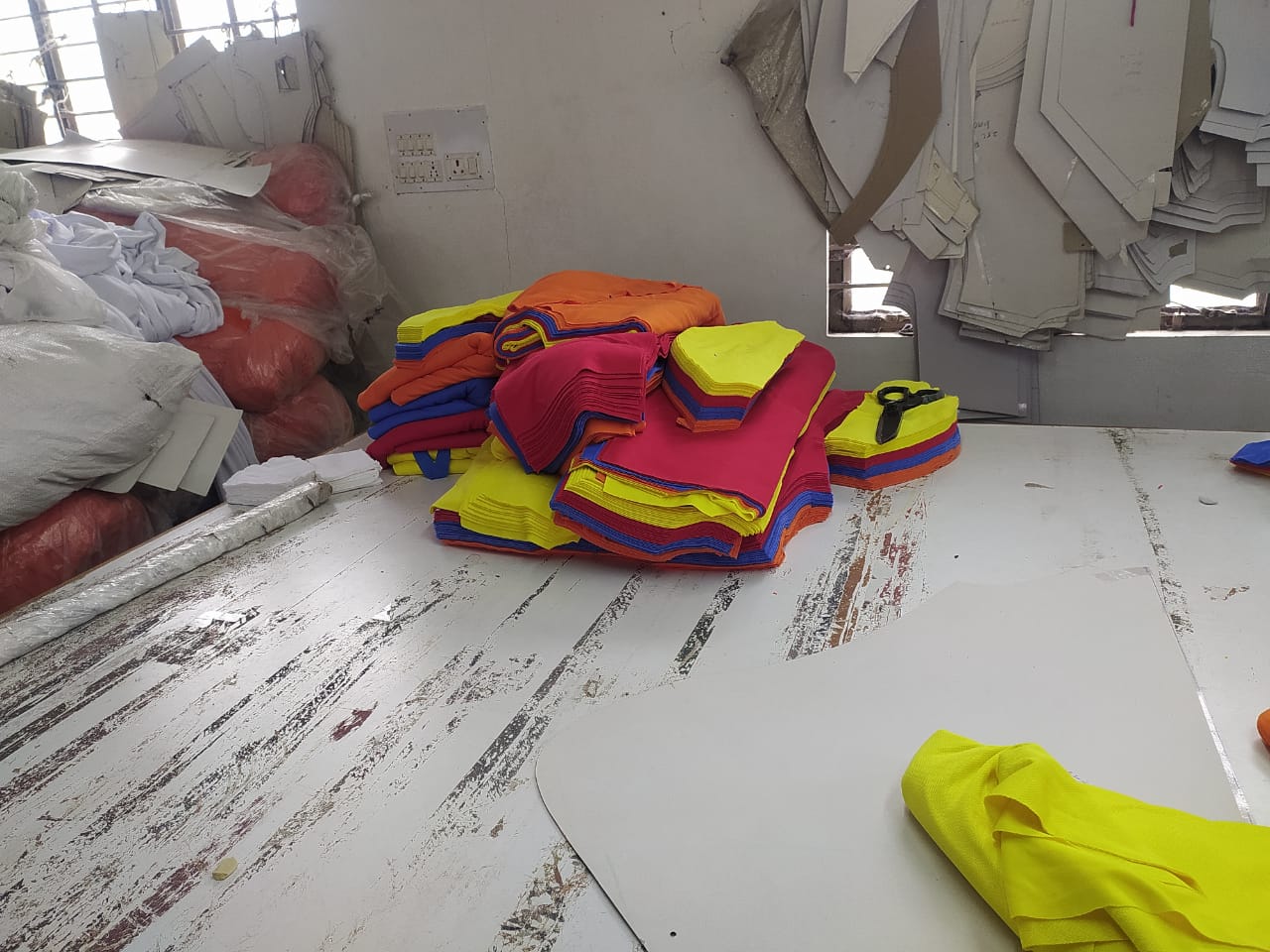
Fabric on a cutting table is a different leftover. The cutter, whether a straight knife through a stacked lay, a wheel, or a laser on a single ply, removes a narrow slot, but the usable remainder is still cloth with a warp and a filling. ASTM D3775 is the test that counts ends in the warp and picks in the filling on woven fabric (page opened 29 September 2026). Those two directions are not interchangeable on the nest. A strip between pattern pieces is not a metal bridge you can later treat as free stock. Selvage, a nap that only looks right one way, and a printed repeat that has to land on a pocket or a collar all turn leftover cloth into scrap even when the area of the rectangle still looks large.
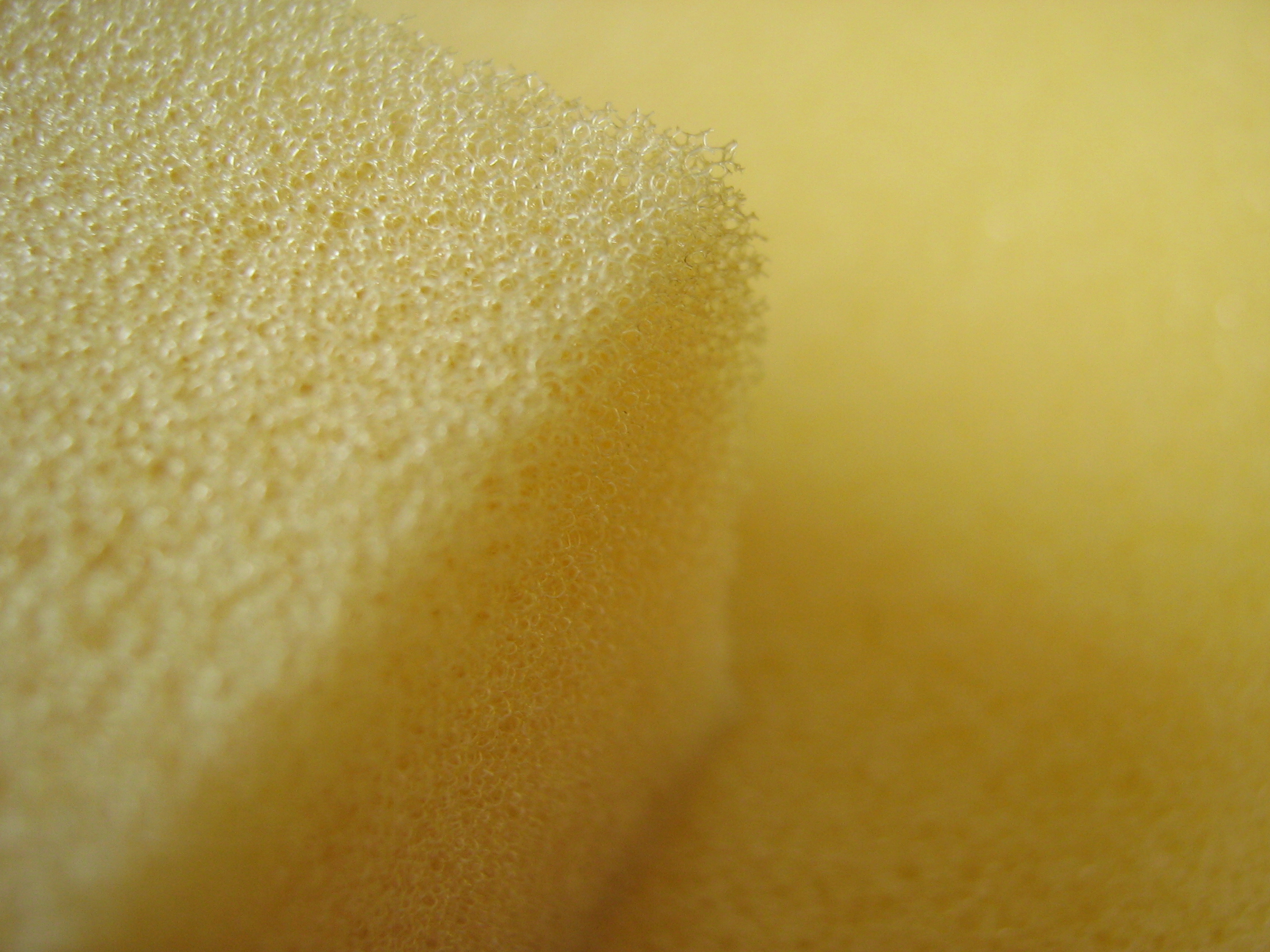
Foam is a cellular blank, not a plate. A saw or a water-only jet opens a slot by removing or displacing cells. OMAX states that foam rubber cuts with a water-only nozzle and no abrasive, which is not the abrasive stream used on metal on the same class of machine (page opened 29 September 2026). The leftover is a bun or a sheet with a cut face. If that face crushed, the piece is not the thickness you programmed, even if the outline still fits the nest drawing.
Label stock is a laminate on a roll: facestock, adhesive, and liner. A kiss-cut die is meant to cut the face and the adhesive and stop at the liner so the waste matrix can be stripped and the labels stay on the web. Avery Dennison’s Fasson spec 77920 states a facestock caliper of 0.0020 in (50.80 µm), an adhesive of 0.0009 in (22.86 µm), and a 50# SCK liner of 0.0032 in (81.28 µm) by ASTM D1000, for a total of about 0.0062 in (154.9 µm). The same sheet describes that liner as having very good diecutting and matrix-stripping properties (data sheet opened 29 September 2026). The leftover is a matrix ladder plus, later, the liner itself. Avery Dennison’s AD Circular page states that 100,000 labels generate over 100 kg of liner waste and that matrix, once stripped, is also discarded (page opened 29 September 2026).
The parts you can point to are therefore different: a blade or a nozzle, a sheet edge and a metal skeleton on plate, a stacked lay and a cloth offcut on fabric, a crushed foam face on a bun, and a matrix and a liner tail on a label roll.
Why a metal nest can flip a part when a textile or label layout cannot
A sheet-metal nest is often allowed to rotate a part and, on many jobs, to flip it. That freedom fills the sheet. It is the same freedom that How nesting changes yield when parts cannot spin freely takes away when a grain, a bend line, or a brushed face is locked. Fabric, foam, and labels start from that locked case: stock whose face, stretch, or print makes a flip illegal even when the silhouette would fit.
Nap is pile that lies in one direction. A panel cut with the nap running up the body will not match a panel cut with the nap running down, even when both panels occupy the same area. Velvet, corduroy, and many wool coatings show that difference in light. The nest that packed both orientations to raise yield produced unusable garments, not extra parts. Stretch is a second lock. ASTM D2594 measures fabric stretch under a known load and fabric growth after a known extension is applied and then removed. The standard’s own significance statement says stretch and growth matter when a fabric must recover its shape, and it does not recommend the method for acceptance testing of commercial shipments because between-laboratory precision is known to be poor (page opened 29 September 2026). A knit panel cut on the bias of the stretch will grow in a different place than the same silhouette cut on the course. Area math does not see that. The coupon does.
A printed repeat is a third lock. ASTM D3882 covers bow and skew of filling yarns and also of printed geometric designs. The same page notes that matching plaids from distorted patterns can create serious problems, and that a wavy or sharp break in the bow line is more detrimental on small parts such as collars and pockets than a gradual slope (page opened 29 September 2026). A nest that rotates a plaid pocket to fill a gap will ship a part whose check does not meet the garment. The area still “fitted.” The print did not.
Label stock has a machine direction and a cross direction even when the print is a solid color. Spec 77920 reports facestock tensile strength of 21,300 psi in the machine direction and 28,400 psi in the cross direction, and liner tensile of 48.0 lb/in versus 26.0 lb/in in those two directions (data sheet opened 29 September 2026). The web also has a print-to-cut register. You do not flip a label on the liner the way you flip a washer on a steel sheet. The waste shape is a matrix whose ligaments have to survive stripping. A nest that crowds small labels until the matrix is too weak does not raise yield. It raises web breaks.
Foam can often be rotated in the plane of the bun if the cell structure is the same both ways, but it still cannot be treated like plate. Thickness is the product. A blank that crushed at the cut is undersize in the one direction the customer pays for. ASTM D3574, which covers tests on slab, bonded, and molded polyurethane foams, states that the data obtained apply to the material under the conditions of that particular test and are not necessarily the same as those obtained in other environments in use (page opened 29 September 2026). A catalog compression set is one environment. A jet, a blade, or a hot wire at the cut face is another.
The comparison that belongs here is sheet versus this family of stock, not laser versus saw. A metal nest that can flip a part counts leftover as skeleton and offcut. A textile or label layout that cannot flip counts leftover as illegal orientation, unmatchable print, unstrippable matrix, or a crushed thickness. Those are different shapes of waste. They do not convert with one percentage.
What to check on the spec sheet, the coupon, and the nest
Open the supplier page for the exact stock, not a generic “foam” or “polyester label” row. The Armacell OleTex BCJN 200 sheet (opened 29 September 2026) names that bun’s density, 25 percent compressive deflection, compression set, and bun sizes of 60 × 72 × 4 in and 48 × 72 × 4 in. Those figures describe that product. They are not a kerf, and they are not a license to nest as if the bun were plate.
For a polyester label laminate, open the construction sheet. Spec 77920 (opened 29 September 2026) separates facestock, adhesive, and liner calipers and reports machine-direction and cross-direction tensile values. Look for the liner’s stated diecutting and matrix-stripping behavior. If the sheet does not name the process you will run, leave the slot width blank.
For woven cloth, the two directions are warp and filling under ASTM D3775. For print or yarn distortion, use bow and skew under ASTM D3882, including printed geometric designs on a plaid or stripe. For stretch, ASTM D2594 states what it measures and also states that it is not recommended for acceptance testing because laboratories do not agree well. Use it as a coupon method on your own fabric, not as a number copied from another mill.
On the coupon, cut the same material, thickness, and process as the job, on the same machine. Record those four facts next to any slot you measure. A catalog nozzle size, a blade listing, or a liner caliper is not that slot. After a blade, nozzle, or die change, the old coupon is no longer the slot. For foam, measure thickness at the cut face after the piece has sat. For fabric, check nap and print match on the coupon against the marker. For labels, confirm that the face is cut through and the liner is not, and that the matrix lifts without taking the label with it.
On the nest, write the rotation rule in the same place you write the part count. If nap, stretch, or print forbids a flip, the count is the locked count. A nest that looks full can still be illegal for that stock.
The decision before the nest or the quote
The choice this topic turns on is whether the nest may rotate and flip, or whether it must keep every piece in one orientation. Fabric with nap or a printed repeat, knit with stretch, foam that can crush, and a printed label web all require dropping the flip—and often free rotation—before you count parts.
That decision changes how many finished pieces the purchased stock can still yield. Cloth that is the wrong nap is scrap, not an offcut waiting for the next size. A crushed foam blank is scrap even when its silhouette nested. A label matrix is not a skeleton you can recut. Quote the purchased roll, bun, or ply, not only the area of the parts that ship.
If you do not know material, thickness, process, and machine, leave the kerf width blank. Do not paste a metal laser slot onto a water-only foam cut or onto a kiss-cut label. Keep an offcut only when another legal part, in the legal orientation, still fits on it.
The foam blank that still fails when the area math said it fitted
The defect that makes a cut piece unusable even when the area math said it fit is not a missing square millimetre on the drawing. It is a part that no longer meets the job after the cut: nap running the wrong way, a plaid that will not match, stretch that grew, a label that lifted with the matrix, or a foam edge that crushed and stayed thin.
On foam that last failure is easy to miss because the nest is a 2-D outline. Armacell’s BCJN 200 compression set of 19 percent is how much of a standard laboratory compression the bun does not recover. It is not the thickness of a blank a jet or a knife flattened at the cut. ASTM D3574 warns that foam test data belong to the conditions of that test and are not necessarily what you get in another environment (page opened 29 September 2026). The cut is another environment. If the coupon’s cut face is thinner than the drawing, the piece is unusable no matter how neatly it nested.
OMAX separates foam, cut with a water-only nozzle and no abrasive, from metals cut with an abrasive jet. That split is a process fact, not a yield percent. A water-only slot still occupies width, and the cells beside it can still collapse.
On fabric the matching unusable defect is orientation. On labels it is a face that did not kiss-cut cleanly, so either the matrix takes the label or the liner is cut and the web fails. In every case the area math can be correct and the piece still cannot ship.
The mistake that makes the count wrong
The harmful mistake is to nest fabric, foam, or label stock as if they were sheet metal that can flip, then to quote only the finished part area. That action counts illegal rotations as extra yield, treats a crushed foam blank as a good part, and leaves liner and matrix off the material line. The customer pays for the roll, the bun, or the ply that had to be bought. A quote built as if leftover were a reusable metal skeleton understates that purchase.
Read next: How nesting changes yield when parts cannot spin freely · What changes when the stock is a coil or a roll instead of a sheet