Why one kerf number cannot stand in for the whole job
Material, thickness, process, and machine each change the slot. Leave the width blank until a record names all four.
A kerf is the slot a saw, a laser, a plasma arc, or a waterjet removes from sheet metal, plywood, acrylic, or plate. That slot is not a constant of the shop. Material, thickness, process, and machine each move it. Before a nest or a quote uses a width, write those four facts next to the measurement, or leave the width blank.
Kerf record at a glance
- What is being counted
- The slot the cutter opens in the stock. ISO 9013:2017 defines kerf width as the width of that cut at the upper edge, or immediately below if the top edge has melted, and it labels a separate bottom kerf width on the same figure. Last checked 29 September 2026.
- What is not being counted
- The finished part size on the drawing, a blade or mixing-tube listing copied from a catalog, or one millimetre reused on every sheet. Last checked 29 September 2026.
- The measurement that decides it
- A slot measured on a coupon cut in the same material, thickness, process, and machine as the batch. Hypertherm’s Powermax45 Duramax cut charts list a kerf only beside those facts, and only as a laboratory starting point. Last checked 29 September 2026.
- What a catalog figure leaves out
- Diablo lists the D1080X 10-inch, 80-tooth wood blade at 0.098 in kerf and the D0724X3 7-1/4-inch, 24-tooth framing blade at 0.059 in kerf. Neither product page states a sheet thickness or the saw on which a slot was measured. Last checked 29 September 2026.
- Check before the batch or the quote
- If material, thickness, process, or machine is missing, leave the width field blank and cut a coupon on the job machine before the nest is locked. Last checked 29 September 2026.
- Last checked
- 29 September 2026
What the cutter is actually removing
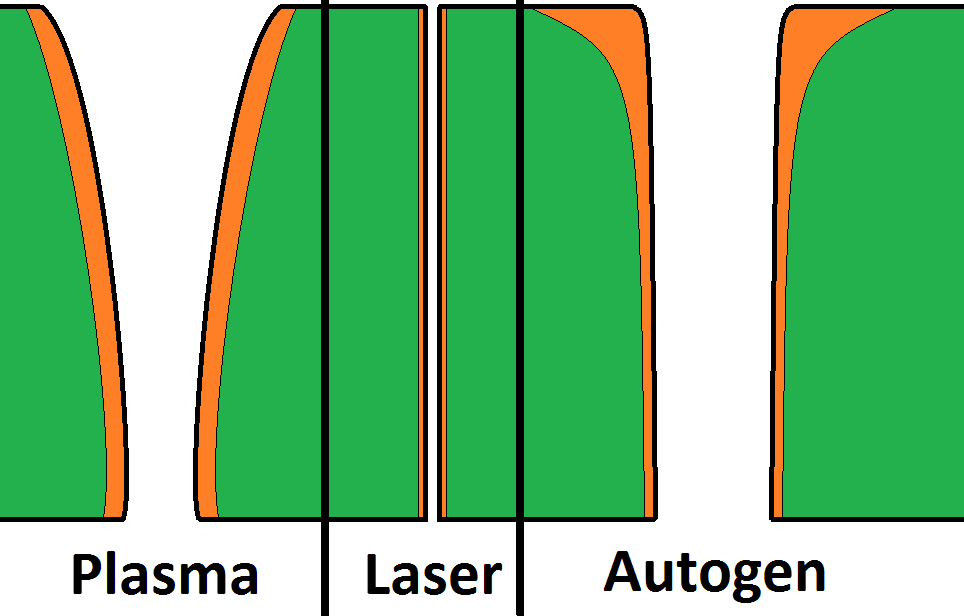
A toothed blade opens a slot wider than the plate because the teeth are set. A laser beam, a plasma arc, and an abrasive waterjet each open a slot by a different mechanism: a focused beam, a constricted arc through a nozzle, or a slurry leaving a mixing tube. ISO 9013:2017 is written for thermal cuts. Its scope covers flame cuts from 3 mm to 300 mm, plasma cuts from 0.5 mm to 150 mm, and laser cuts from 0.5 mm to 32 mm. The same document does not treat those processes as one thickness band, and it does not give a single kerf for all three.
On the work you can point to the blade or the nozzle, the top of the sheet, the bottom of the sheet, the skeleton left after the parts come out, and the offcut that may or may not hold another piece. The loss that belongs in a kerf record is the slot itself, not the leftover sheet and not the part on the drawing. ISO 9013:2017 clause 3.4 measures that slot at the upper edge of the cut. Figure 1 of the same standard still draws a top kerf width and a bottom kerf width as two different labels. A number that does not say which face was measured is already incomplete.
Why a catalog width and a coupon fail in different ways
A catalog width and a measured coupon fail in opposite directions. The catalog is tied to a named consumable. It is not tied to the sheet on the table. Diablo’s D1080X page lists a 0.098 in kerf for that 10-inch, 80-tooth wood blade. The D0724X3 page lists a 0.059 in kerf for that 7-1/4-inch, 24-tooth framing blade. Those two figures are maker listings for two different blades. Neither listing is a slot in a named plywood thickness on a named saw. Copying either number onto a laser nest, a plasma nest, or a different blade is the catalog failure.
A coupon fails the other way when the shop treats one measured slot as a house constant. Hypertherm’s Duramax machine-torch cut charts for the Powermax45 state that kerf widths were taken with the Best Quality settings, under laboratory test conditions, with new consumables, and that they are for reference only. The same page says differences between installations and material composition may cause actual results to vary, and that the charts are a starting point to adjust. A coupon cut last month on a different thickness, a different alloy, or a worn nozzle is not the slot for this batch, even though it was a real measurement.
The related topic on how to read a blade, nozzle, or lens listing for kerf is the catalog side of that split. This page is the record side: the listing is allowed only as the maker’s figure for that consumable, and the coupon is allowed only for the four facts written next to it.
What to look for on the spec sheet and the coupon
Open the maker page for the blade, nozzle, or torch you actually have, not a roundup. On 29 September 2026 the Diablo D1080X and D0724X3 pages each printed a kerf in the technical specs for that model. The OMAX ProtoMAX specification listed a mixing tube 2.25 in long with a 0.030 in internal diameter, and a 0.008 in orifice. The ProtoMAX knowledge base, on the same date, stated that with a 0.030 in mixing tube the kerf can range from 0.015 in (0.38 mm) to 0.060 in (1.52 mm), depending on the nozzle, the thickness of the material, and the amount of wear on the mixing tube. That range is not a kerf you can paste onto every waterjet nest. It is evidence that one mixing-tube listing still leaves thickness, wear, and the rest of the nozzle stack unspecified.
On Hypertherm document 810050, revision 0, January 2018, the mild-steel 45 A air shielded chart for a Duramax machine torch on a Powermax45 lists 1.4 mm kerf at 1.5 mm thickness, 1.9 mm kerf at 12 mm thickness, and 3 mm kerf at 25 mm thickness. On the 10 mm row of the same family of charts, mild steel is listed at 1.8 mm, stainless steel at 1.6 mm, and aluminium at 1.9 mm. Those figures sit next to material, thickness, amperage, gas, and consumable type. They still carry the maker’s warning that they are reference values from a laboratory with new consumables. They are not a shop database.
A useful record therefore names four things next to any width: the material, the thickness, the process, and the machine. If the page you opened states only a blade kerf, write that it is a catalog figure for that blade and leave the job width blank. If a coupon exists, write the four facts and the measured slot. ISO 9013:2017 also asks which face you measured, because top kerf and bottom kerf are not the same label.
The decision before the nest or the quote
The choice this page turns on is whether the width field may be filled. Fill it only when material, thickness, process, and machine are all known for the batch on the table. If one of the four is missing, leave the width blank. Do not copy a millimetre from another job, another alloy, another thickness, or another cutter.
When the four facts are known, still treat a catalog figure as a starting point, not as the slot. Hypertherm says to use the cut charts as a starting point and to adjust for the equipment and the environment. OMAX says mixing-tube wear itself moves the kerf inside a published range. Remeasure on a coupon in the same material, thickness, and machine as the job before the nest is counted and before the quote treats the wasted strip as a known width.
If the process changes — saw to laser, plasma to waterjet, shielded 45 A to FineCut — the old width does not travel with the file. Leave it blank and measure again. The related topic on what a test coupon is for before a kerf number is used on a batch is the measurement step that follows this decision.
What one plasma cut chart still refuses to be
On the same Powermax45 Duramax mild-steel charts, the shielded 45 A row at 1.5 mm lists 1.4 mm kerf, while the FineCut chart at 1.5 mm lists 1.2 mm kerf. That is one machine family, one alloy name, one thickness, and two consumable sets. The maker still printed both numbers only as laboratory reference values. A shop that stored “1.4 mm for mild steel” would already be wrong on the FineCut setup, and would still be wrong on a worn torch or a different table even on shielded 45 A.
The waterjet side of the same rule is the 0.030 in mixing tube that OMAX says can cut a slot from 0.015 in to 0.060 in as nozzle, thickness, and wear change. The saw side is two Diablo listings, 0.098 in and 0.059 in, for two named blades and no named sheet. In each case the published number is usable only as what that page actually states. It is not a kerf for the whole job.
The mistake that ruins the count
The harmful mistake is copying one width onto every nest, every quote, and every material page. One millimetre reused as a house kerf overstates or understates the strip between parts, so the sheet count is wrong and the quote is wrong. If any of the four facts is missing, the width stays blank. A copied number is not a kerf database.
Read next: How to read a blade, nozzle, or lens listing for kerf · What a test coupon is for before a kerf number is used on a batch